
A Beginner’s Guide to the Feng Shui Bagua Map
Last updated: February 23, 2026 • 9 minute read
The Feng Shui Bagua: An energetic blueprint for your home
Imagine your home as a living, breathing entity, with energy flowing through every room, corner, and hallway. The Bagua map is a powerful tool in Feng Shui that helps you decode this energy flow, aligning your physical space with your life’s aspirations.
The map looks like a tic-tac-toe board, dividing your home into nine equally sized distinct areas, each representing vital aspects of life such as career, relationships, health, and prosperity. Once you have this for your home, it is easy to start paying attention to which areas of your life need some extra support, and then applying feng shui principles to those corresponding sections or guas, to help correct the energy flow and create a sanctuary that supports your highest intentions.
We start at your front door. This is going to be the architecturally intended entrance to your home, whether you use it the most or not. I hope you do. If you use the garage door or a side door more often, that does not change where you will stand for the purposes of creating this bagua map of your home.
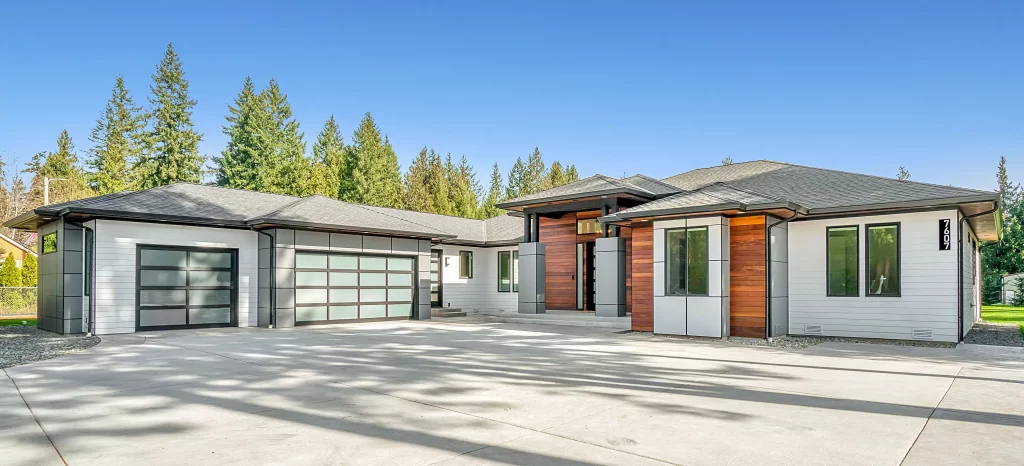
How do I draw my floorplan if I don’t have one?
If you don’t have a floorplan from the builder or it’s an older home, sketch it on grid paper, more or less to scale. Stand at your front door looking in and draw from there. It does not have to be perfect, but it helps with clearly defining the different life areas and where they fall on your floorplan.
- Step 1 – Get a piece of blank paper, pencil and a tape measure.
- Step 2 – First draw an overall rough sketch of your entire floorplan, mainly the exterior walls.
- Step 3 – Then go to each room, stand at its entrance and mark where the doorways and interior walls are.
- Step 4 – Start measuring the main 4 walls of each room – you don’t need to measure windows or furniture. It does not have to be exact, a few inches here and there is OK.
But, for example, if a bathroom is half the length of the bedroom, it should kind of look like that on your plan. Create a simple scale, something like 1 inch = 2 feet.
You can work with this plan, but if you are really picky, like me, go to Step 5. - Step 5 – If you would like to have your floorplan to scale, sketch out the floorplan on graph paper, with your chosen scale. This could be 1 square = 1 foot. Keep it simple.
Found a great youtube video explaining this very simply.
How to make a floorplan with graph paper by Tessie Fae Design
Check it out if you are confused. You don’t need to get that detailed with closets and windows for our purposes. Only focus on the main exterior and interior walls and the doorways.
Now you have a basic floorplan to start working with.
Email this article to yourself
Want to save this for later? Enter your email and we’ll send you the link.
How to lay the bagua grid on my floorplan
Once you have the floor plan done, you will superimpose the bagua grid (3×3) over your plan. This can be done manually by measuring your floor plan and dividing it into 9 equal rectangles. Or you can draw it on tracing paper and place it on the floorplan sheet. If you have Photoshop or Illustrator, or know some other software that can layer a transparent grid on top, that’d be the best.
Most homes are not going to be a perfect square or rectangle. There are going to be balconies jutting out, or a porch sticking out, or an inset open air seating area, or a covered patio, etc. That is okay for now. Follow the rules below to make sure you have placed your bagua map correctly over the floor plan.
One of the main rules is that the bagua squares have to be the same size for each section or gua as it is called. You will stretch the entire 3×3 grid as a whole to cover your floor plan, not only parts of some squares.
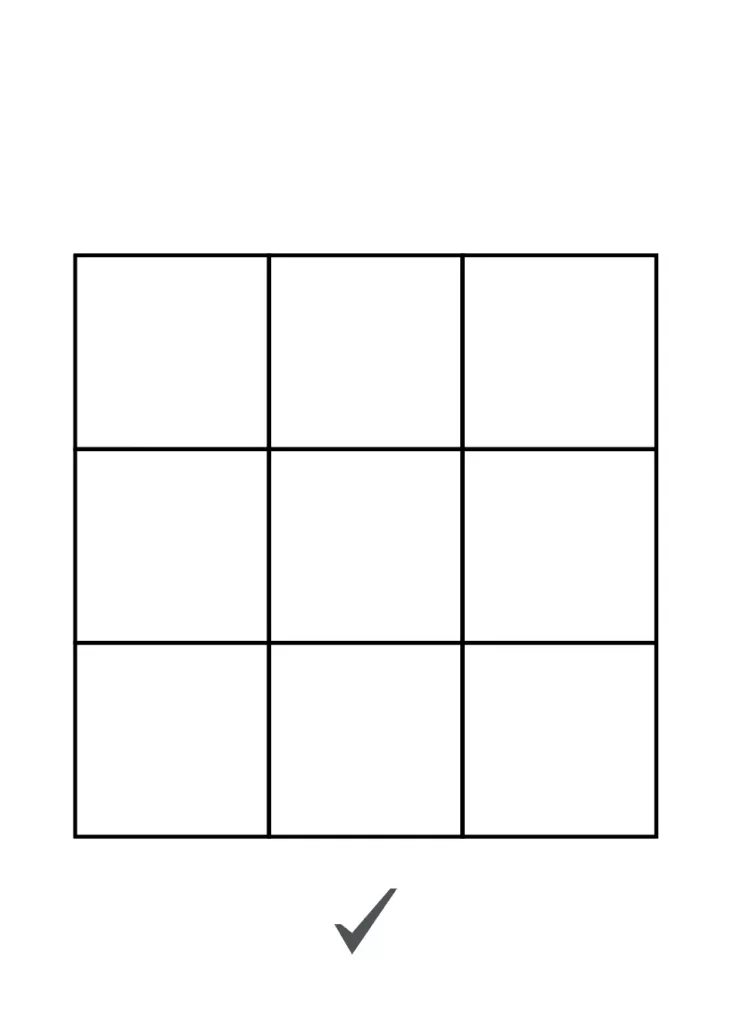
Equal grid squares for all 9 sections
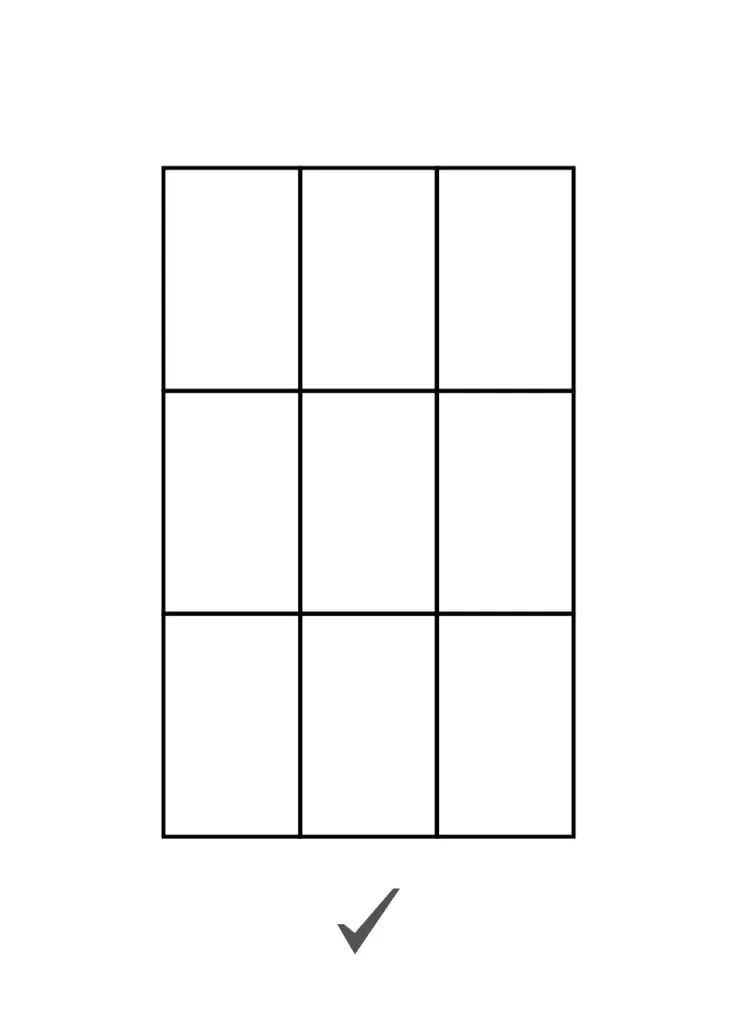
Grid stretched to fit a longer floor plan but each section is still the same size.
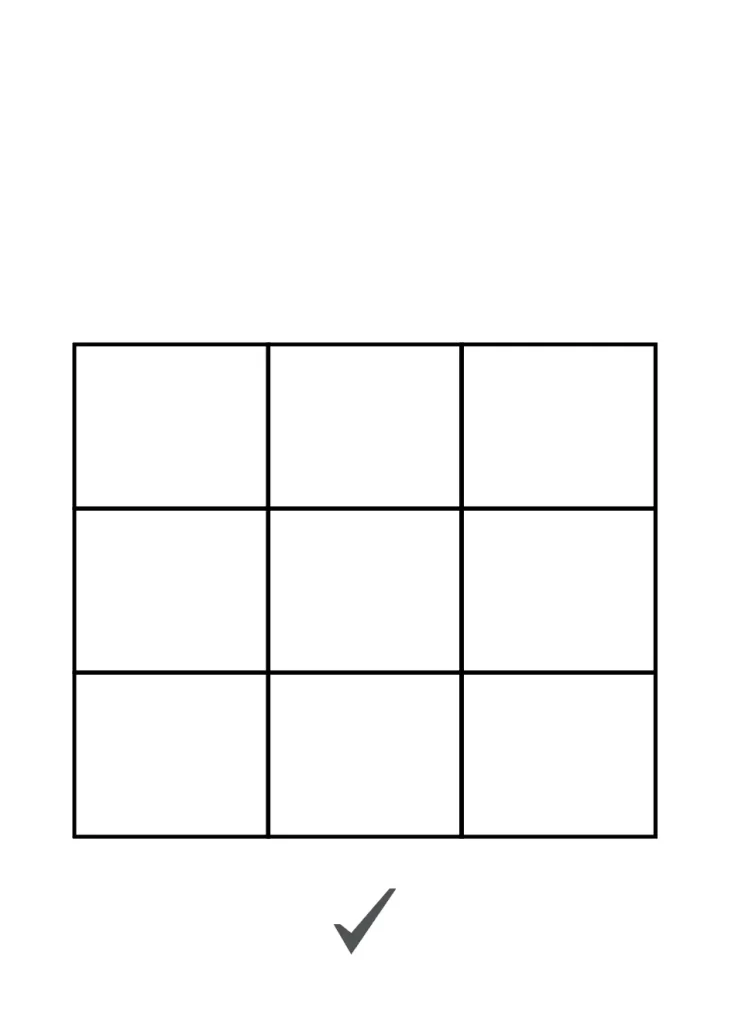
Bagua stretched sideways to fit a wider home. This is fine.
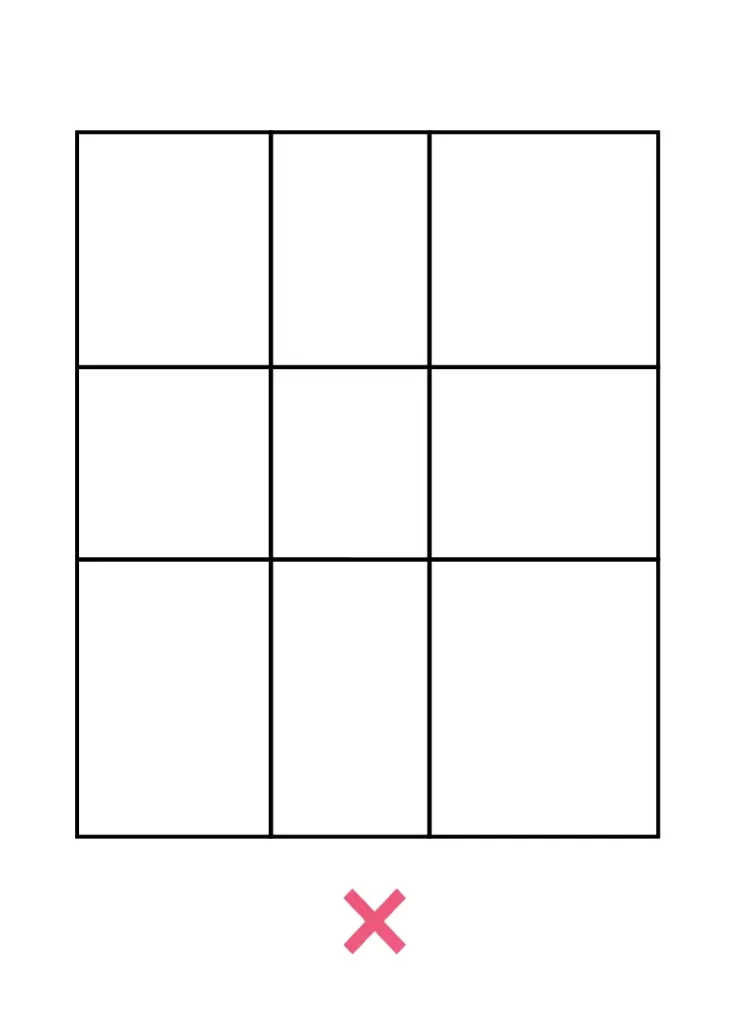
Note how each of the 9 guas aren’t the same size. This bagua is stretched incorrectly.
Things to look out for before drawing the bagua on your floorplan
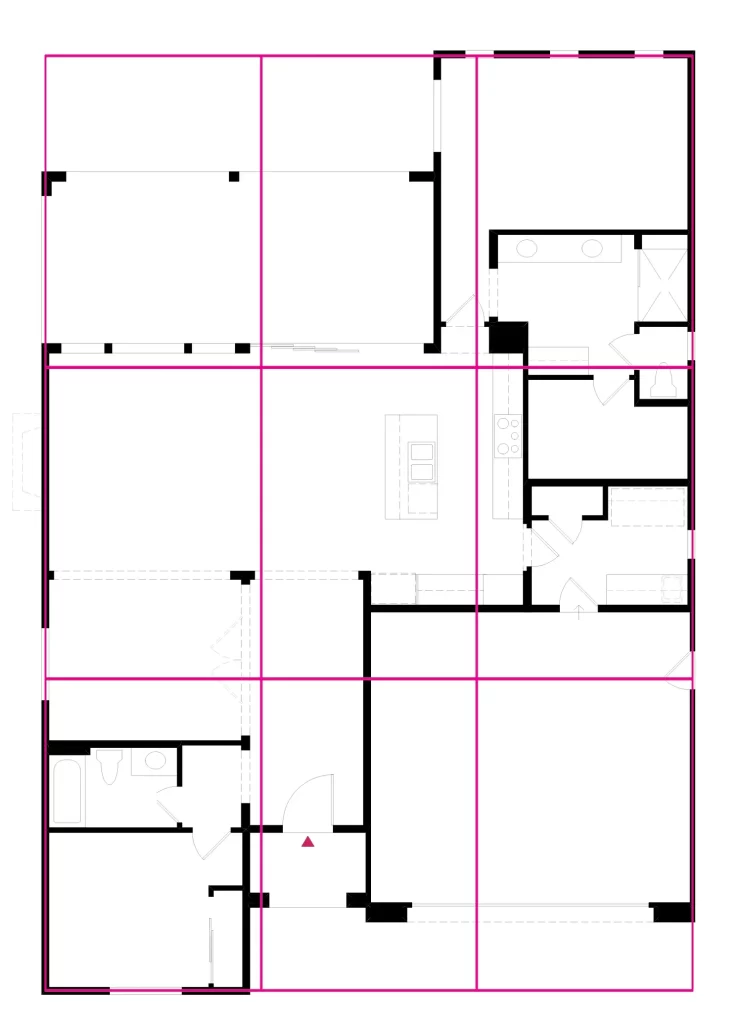
- Always line up the bottom of the bagua map with the main entrance of your home first. See example below. The red triangle is the main door.
- After that, check to see what parts of your floorplan are extending outside the pink lines (bonus areas), or are cut out (missing areas) from your plan. These are still a part of your main home, as long as it is under the roofline. All areas that are under the main roof, should be covered by the bagua map.
- So now, you may have to stretch your bagua map to cover rooms / porches, patios that are connected to the main house and roof.
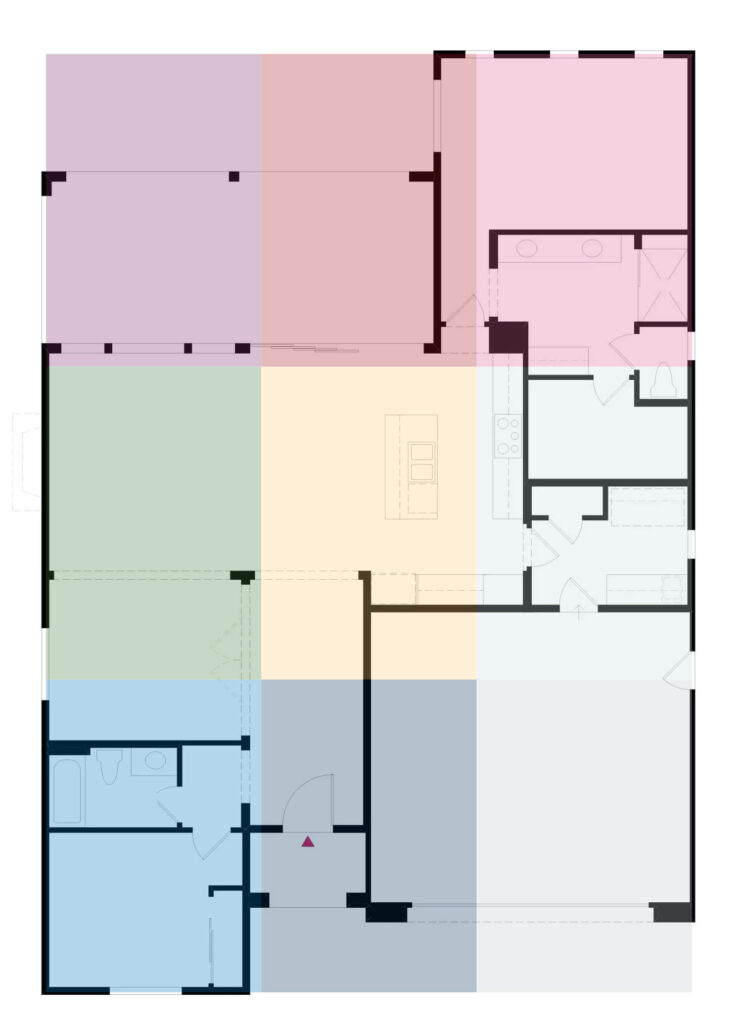
In the example below, the bottom part of the bagua map has been extended past the front door since the left side bedroom extends past the door.
The top left area of the bagua also covers some extra yard that’s not the house since the right side exterior wall juts out further.
The bagua may cover some open areas that aren’t part of your home’s structure. These will be missing areas or bonus areas that will be remedied when we get to the shui.
Sample Floorplan
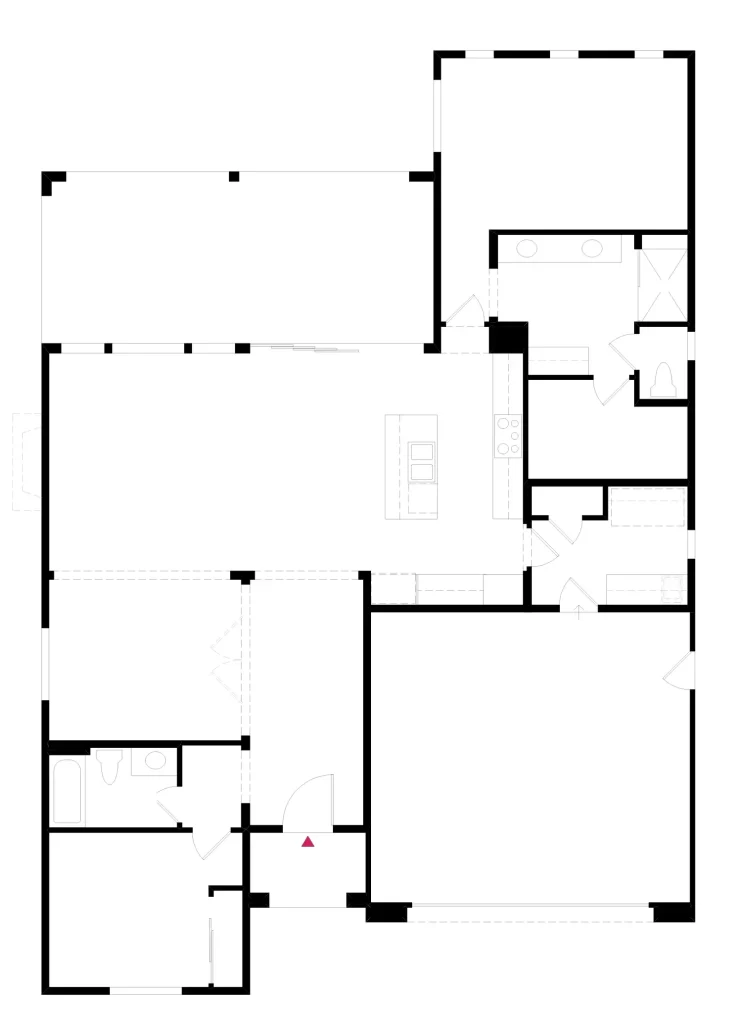
Sample Floorplan with BaGUA Superimposed
What are the 9 different areas of the Bagua map?
Each of the 9 areas in the bagua map represents a specific aspect of your life, such as career, relationships, health, or wealth. These areas are deeply rooted in classical Taoist philosophy and are derived from the Eight Trigrams (Ba Gua) of the I Ching, one of the oldest Chinese wisdom texts. The ninth area, the center, represents overall balance and harmony, as it touches all the other 8 areas and is the heart of your home and life.
Each of these 9 areas carries with it a unique set of energetic signatures that help you understand and activate the chi (life force energy) of your space in a conscious, aligned way:
🧭 Direction – Each area corresponds to a compass direction (like North, Southwest, etc.). These directions aren’t just physical, they also carry symbolic meaning in Feng Shui and can influence how energy moves in that part of your life.
🔢 Number – The areas are traditionally numbered 1 through 9. These numbers are based on the Lo Shu magic square, an ancient numerology system that reflects natural harmony and cosmic order.
🎨 Color – Each zone is associated with a specific color or palette that supports and activates the chi in that area. For example, the Wealth area is linked with purples and golds, while the Career area is connected to deep blacks and water tones.
🦋 Life Area – This refers to the aspect of our lives each section governs—like Career & Life Path, Relationships & Love, Family & Health, or Fame & Reputation.
🌿 Element – Each area is also governed by one of the 5 elements — Wood, Fire, Earth, Metal, or Water. These elements represent natural forces that shape your environment and life. Balancing these elements creates flow, vitality, and energetic alignment.
By mapping these onto your home, you get a mirror of how your environment is supporting (or challenging) your personal journey.
The nine areas of the Bagua map, individually known as guas are:
- Knowledge & Self-Cultivation (Gen): Bottom left
- Family & Health (Zhen): Middle left
- Wealth & Prosperity (Xun): Top left
- Fame & Reputation (Li): Top center
- Love & Relationships (Kun): Top right
- Creativity & Children (Dui): Middle right
- Helpful People & Travel (Qian): Bottom right
- Career & Life Path (Kan): Bottom center
- Center (Tai Qi): Middle square, touches all the other guas
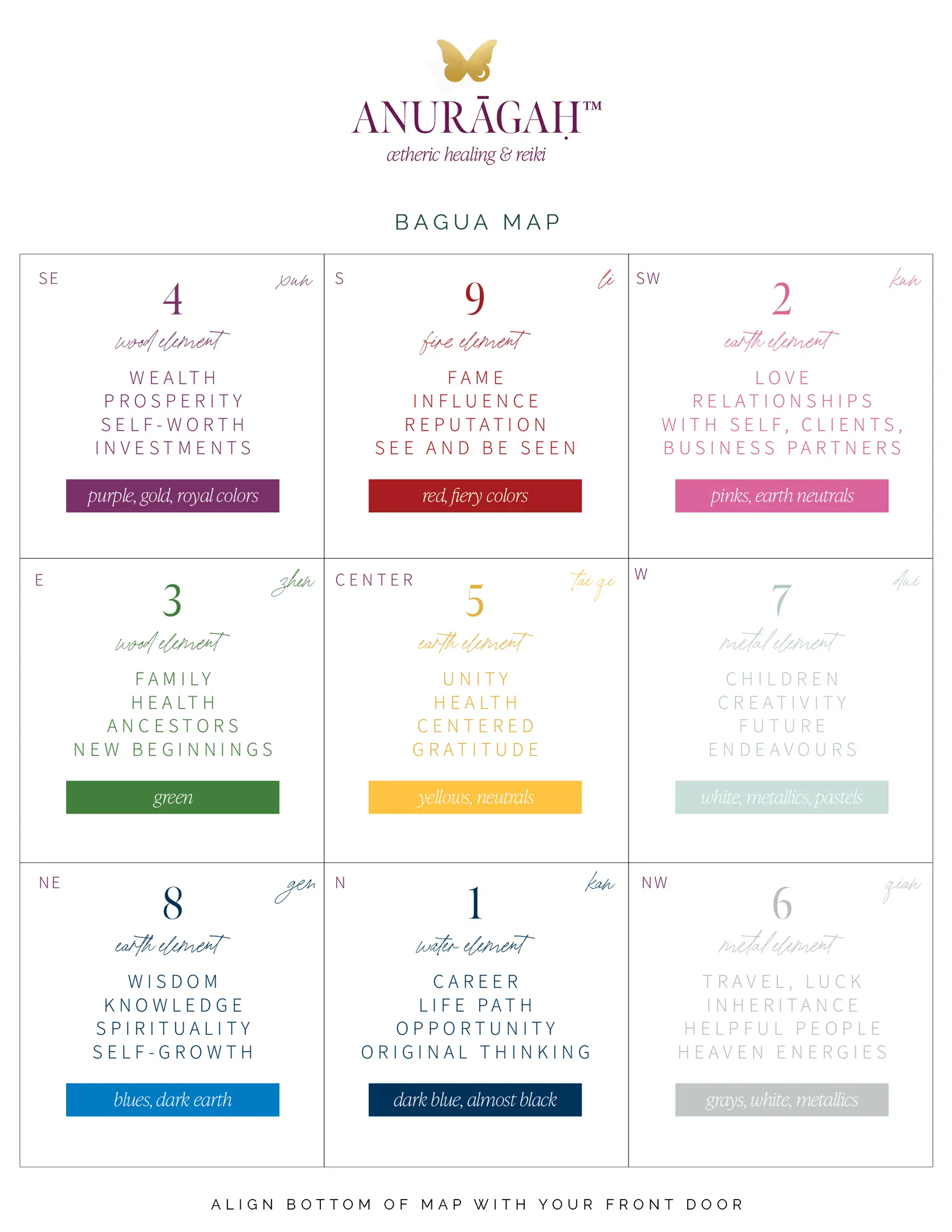
Access our Freebie Portal to download print quality, hi-res transparent Bagua maps to try it out with your floorplan.
See samples below on how the bagua map is superimposed on a floorplan.
Sample Floorplan with BAGUA MAP COLORS
Sample Floorplan with BaGUA Superimposed
Q & A
Can the bagua map be applied to multi-story homes?
Yes! To begin with, start with applying the bagua to the main floor. And it is replicated in that same position for other floors or basements. So even if the 2nd floor is not a complete floor, it covers only certain parts of your main floor (when one has high ceilings in some areas), the bagua map position will not change.
When you are ready to treat each floor separately, you can also lay the bagua individually for each floor standing at the entrance to that floor. So the top of the stairway will become the ‘main door’ for that floor.
Can I apply the bagua to smaller areas in my home?
Absolutely! Once you have understood the map, you can now take it further by doing a macro view like overlaying the bagua on your entire lot area. This means it will cover your home and any front yard and backyard space. That is all the land owned by you.
Or, you may choose to do a micro view – lay it on an individual bedroom, your living room or your office desk and enhance those areas of a particular gua that you feel you need extra support in, at this time in your life.
What if a room overlaps multiple Bagua areas?
It’s very common for rooms to cover multiple bagua areas. Identify each area’s energy separately within that room, and thoughtfully enhance each distinct zone accordingly.
I have a section of a gua missing. What should I do?
Missing areas or bonus (extra) areas are quite common as there are no homes that are built perfectly square or rectangular. Read this blog post (coming soon) on how to specifically address this concern.
Don’t forget to pin this for later!

Email this article to yourself
Want to save this for later? Enter your email and we’ll send you the link.